Move Your Body: the story of the record
"Move Your Body" by Marshall Jefferson is the record that gave house music its piano and its anthem. A Chicago postal worker wrote it in his head on the night shift, Ron Hardy played it six times in a row at the Music Box, and it spread around the world on cassette before it was even pressed. Its subtitle says what it became: "The House Music Anthem".
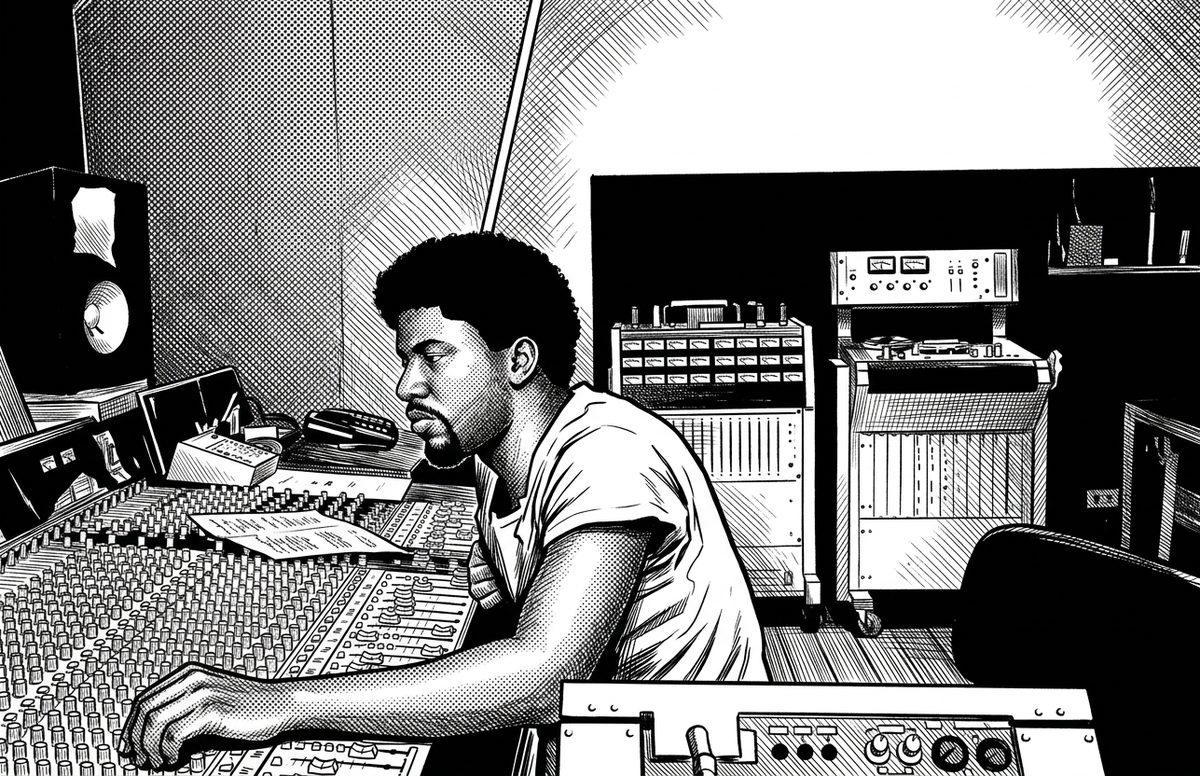
At a glance
| Artist | Marshall Jefferson (as producer: Virgo) |
|---|---|
| Released | 1986, Trax Records (TX117), Chicago |
| Also known as | The House Music Anthem |
| Written, produced and arranged by | Marshall Jefferson |
| Vocals | Curtis McClain, backing vocals by On The House |
| Piano intro | Rudyard Forbes |
| Mixed by | Ron Hardy (credited on the Trax pressing) |
| Original length | 7:38 |
Chicago, 1983 to 1985: from the post office to the studio
Marshall Jefferson was not a DJ. He worked nights at the Chicago post office, typing in postcodes. In late 1983 a colleague, Lynn Montgomery, took him to the Music Box for the first time, and from then on he was "all the way house music", as he puts it in DJ Mag's making-of film.
He went back to work and talked his colleagues into making records. With Curtis McClain, Rudy Forbes and Thomas Carr he formed a group called On The House. The push came from a record shop: he bought Jesse Saunders' "Hot Hot Hot", thought he could do better, and decided that day to make records himself.
He bought a Yamaha synthesizer, a sequencer, a keyboard, a drum machine and a mixer, around $9,000 worth of gear on credit, and set up a studio at home.
Making the record: a piano in his head
The song arrived during a shift. "I heard the piano first," Jefferson says in the DJ Mag film, and the bassline followed from there. At home he programmed the parts into his sequencer, then called On The House into the studio. He played everything in at a crawl, around 40 beats per minute, and sped it up to 120, because as he admits he was a complete novice. The music took one take of 10 to 15 minutes. Curtis McClain sang a lead vocal on words Jefferson wrote in the studio, about the very scene they were part of.
The piano was the bold part. House records of the time were built on drum machines and basslines, and Insomniac notes that some call "Move Your Body" the first house track with a piano, a claim it calls debatable. Either way, that rolling, almost barrelhouse riff became the model for a whole strand of piano house. The Trax pressing credits the piano intro to Rudyard Forbes, one of the On The House crew.
Not everyone heard it straight away. Jefferson first took the tape to the Sheba, Baby disco, where Mike Dunn, Hugo Hutchison and Tyree Cooper were DJing. Their reaction was polite, not the explosion he had expected.
Ron Hardy breaks it
The explosion came at the Music Box. Jefferson handed Ron Hardy the cassette, and Hardy played it six times in a row, covering the gaps with a special effects unit while he rewound the tape. The room went wild. It was the same club where Hardy was already playing his own edits of records like Isaac Hayes' "I Can't Turn Around", the source of "Love Can't Turn Around".
Hardy stayed close to the record. He put it on his own mixtapes and asked Jefferson to keep it away from Frankie Knuckles. A friend passed it on anyway, Knuckles started playing it too and sent a copy to his friend Larry Levan in New York, who played it at the Paradise Garage. When it finally came out, the Trax pressing credited Ron Hardy as mixer.
A hit before it was a record
Pressing it was the hard part. Jefferson paid Trax boss Larry Sherman $1,500 to press 1,000 copies. Sherman did not like the piano and did not think it was house music, so he sat on it. Jefferson remembers eight months, Insomniac says 13.
In the meantime the tape travelled. According to Jefferson it reached Alfredo in Ibiza, then DJs in the UK, and Jazzy M started calling him from London. Journalists flew to Chicago to find out what this house music was, and interviewed him about a record that did not exist yet. Only when the demand was impossible to ignore did Sherman press it.
Virgo, Trax and the rights
The label brought new trouble. Around Chicago Jefferson was known as Virgo, but Sherman put the record out under his real name, with "produced by Virgo" in small print. The other members of On The House were not named at all, and Jefferson says it cost him those friendships.
He also says he never saw any money from his biggest hit, not even the $1,500 he paid for the pressing. According to Insomniac he only gained ownership of the track in 2012. In the DJ Mag film he says he is still fighting for the last parts of the sound recording.
A club anthem, not a chart hit
Unlike "Love Can't Turn Around" and "Jack Your Body", "Move Your Body" never became a pop hit. Its only entry in the UK Singles Chart is one week at No. 100 in January 1990. Its success happened on dancefloors, mixtapes and DJ charts, which is exactly where anthems are made.
Versions and reissues
| Year | Release | Label, catalogue no. | Notes |
|---|---|---|---|
| 2025 | Life Is Simple (Move Your Body) | Rework with Maesic and Salomé Das, according to Eats, Drinks and Leaves | |
| 2019 | Move Your Body (Solardo) | Jefferson's re-recording, remixed | Remix by the Manchester duo Solardo; Jefferson says it went gold and was No. 1 on Beatport for almost three months (DJ Mag film) |
| 1997 | Move Your Body (Jeff Mills) | International Deejay Gigolo, Gigolo 02 | Techno track built on a sample of the original, see below |
| 1986 | Move Your Body (House Music Anthem) | DJ International | Re-recorded 10-minute version, which Jefferson later regretted (Insomniac) |
| 1986 | The House Music Anthem | Trax Records, TX117 (US) | Move Your Body (7:38), Dub Your Body (7:30), Drum Your Body (5:40), House Your Body (7:38) |
According to Insomniac, Jefferson had planned to release the record on his own label Other Sides, and Sherman scratched out the original catalogue number and replaced it with a Trax number.
A nod from Detroit: Jeff Mills
Ten years after Trax, the record turned up in an unexpected place. On his 1997 Shifty Disco E.P. on the International Deejay Gigolo label, Detroit techno producer Jeff Mills included a track called "Move Your Body", built on a sample of "The House Music Anthem". At 4:46 it is short, looped and stripped down, a techno DJ's tool rather than a remix. It is a small footnote next to Ron Hardy's role, but it shows how far the record had travelled by then.
Why it still matters
"Move Your Body" did for house music what a good anthem does for any scene: it gave it a name to shout. The record put the piano at the centre of house, and its way of travelling, from a cassette at the Music Box to the Paradise Garage, Ibiza and London before it was even pressed, became the model for how club records break.
It also carries the darker side of early Chicago house. Like "Love Can't Turn Around", it is a story of credits left off and money that never arrived, and Jefferson spent decades trying to win his record back.
He still plays it. He starts his DJ sets with new music, he says in the DJ Mag film, but when "Move Your Body" comes on it is still the biggest record of the night. He jokes that he must have played it over 10,000 times, which is surely more a figure of speech than a count, but after nearly 40 years it has clearly been a lot. Records like this show up every month in the "Still in the bag" corner of our chart, and the Classics page collects their stories.
Questions
Who made "Move Your Body"?
Marshall Jefferson, a Chicago postal worker, wrote and produced it under the name Virgo. Curtis McClain sang lead vocals, with backing vocals by their group On The House.
When was it released?
In 1986 on Trax Records in Chicago, as "The House Music Anthem" (TX117). It had already circulated on cassette for months.
Was it the first house record with piano?
It is often called that, and it made the piano a house staple. Whether it was really the first is debated.
What did Ron Hardy have to do with it?
He broke the record at the Music Box by playing the cassette six times in a row, and he is credited as mixer on the Trax pressing.
Is there a Jeff Mills version?
Yes. Jeff Mills' track "Move Your Body" on his 1997 Shifty Disco E.P. is built on a sample of the original.
Did it chart in the UK?
Only briefly: one week at No. 100 in January 1990. It became an anthem in clubs, not in the pop charts.