Can You Feel It: the story of the record
No vocals, no hook, no drop. Just a rubbery bassline, a drum machine and three soft chords that never quite resolve. "Can You Feel It" was made by a Chicago drummer with two cassette decks and the first synthesiser he ever owned, and it is widely seen as the moment house music became deep. Billboard ranks it the third best house song of all time, and for many DJs it is simply the best. Here is how it came about.
At a glance
| Artist | Mr. Fingers (Larry Heard) |
|---|---|
| First recorded | Around 1984, in the same period as "Mystery of Love" |
| First release | 1986, Trax Records, TX127, on the "Washing Machine" EP |
| Length | 5:45 |
| Gear | Roland Juno-60 synthesiser, Roland TR-909 drum machine, two cassette decks |
| Famous versions | 1988 UK 12-inches with Chuck Roberts' "My House" sermon and with Martin Luther King's "I Have a Dream" |
| The voice | Chuck Roberts, "The Voice of House Music", on the most played version |
| Accolade | No. 3 in Billboard's 50 Best House Songs of All Time (2025) |
Larry Heard: a drummer in Chicago
Larry Heard grew up in Chicago in a family that expected him to become an architect. In a public conversation at the Red Bull Music Festival in Moscow in 2018 he said he had also considered teaching or law. Music won. He started on guitar, moved to bass and then to drums, learning mostly by listening to records, and he got his first drumming job by bluffing that he could already play.
From 1977 he spent years in cover and progressive rock bands. In Resident Advisor's video "How Larry Heard made house music deep" he explains why he left: "I don't think it was really all that customary for the drummer to have creative ideas, they just played the beat." So he quit his last band and, with savings from a government job, bought a synthesiser and a drum machine. He has always insisted it was "more just practicality than me being a techno geek".
He had no idea what house music was. A friend on his block listened to his first experiments and said they sounded like the music they played at the Warehouse, Frankie Knuckles' club. "Okay, what is this Warehouse place?" Heard remembers thinking. His old bandmates were less impressed. They had been playing Mahavishnu Orchestra and Frank Zappa, and now this was just a simple, straight beat.
Making the record: two cassette decks and the snow
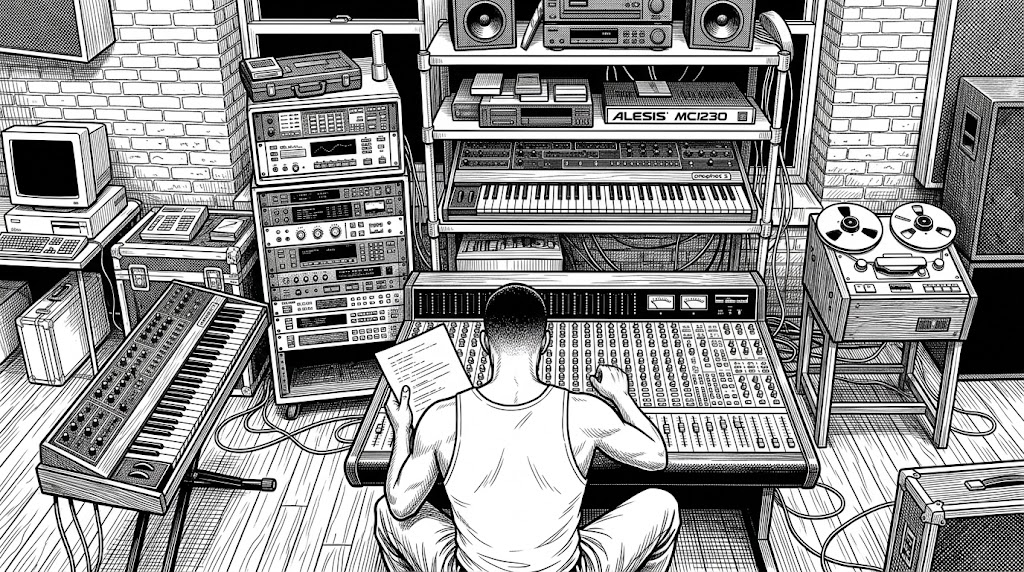
The gear was a Roland Juno-60 synthesiser and a Roland TR-909 drum machine, bought, as Roland's own history notes, with savings from his government job. The Juno played both the bassline and the chords; the 909 played the drums. There was no multitrack recorder. Heard told Vice in 2017 that he recorded one take onto a cassette, played it back into a second cassette deck and added parts by hand as it ran. It was, in his words, far from "exactly the Beatles".
According to Insomniac, the first version was taped around 1984, in the same period as a slower early take of "Mystery of Love", his first house track. Heard himself says there is no grand story. "I can't say there's a specific story around the making of the track," he told the audience in Moscow. What he does remember is a picture: listening back while snow fell outside his window, "and it looked like it was falling in slow motion".
Even the name was not his. A friend suggested "Can You Feel It", and it remains the only one of his tracks he did not title himself.
The tape made its way to the DJs who mattered. Frankie Knuckles and Ron Hardy played it, and it reached Trax Records, which released it in 1986 on the "Washing Machine" EP, catalogue number TX127, next to the title track and "Beyond the Clouds". The deal would follow Heard for decades: in 2019 he and Robert Owens sued the label over unpaid royalties.
The birth of deep house
In Chicago, "deep" was a word before it was a genre. In the Resident Advisor video, the producer Ron Trent explains that it was simply what people called the music Frankie Knuckles and Ron Hardy played: disco, jazz, the underground, "the non-accessible stuff". Larry Heard took that feeling and put it into the new machine music.
The difference is in the harmony. Most early house anthems were built for jacking. "Move Your Body", released the same year, rides the classic one-four-five progression that also drives "Wild Thing". "Can You Feel It" moves through soft minor seventh chords instead, the kind of extended chords that give Debussy and Satie their bittersweet stillness, as the RA video points out. Heard's jazz ear did the rest: the three-chord pattern sits in closely clustered notes, and the Juno bassline has, in Insomniac's words, "one of the most identifiable tones in electronic music".
The result was house you could feel as much as dance to. Billboard sums it up: the track "became the blueprint for deep house". Heard himself has never cared much for the label. Sub-genres confuse him, he said in Moscow: "I just wanted to get straight to the music." But the term stuck to him, and he is widely called the father of deep house.
The spoken versions: Chuck Roberts and Martin Luther King
In Britain the track found a second life in 1988, with other people's voices on top. Two UK labels released versions credited to Fingers Inc., the group Heard had formed with the singers Robert Owens and Ron Wilson.
The first, and by far the most important, laid Chuck Roberts' spoken sermon from Rhythm Controll's "My House" over Heard's groove: the creation story of house music, told like a preacher in a Chicago church. It was released in Britain in 1988 on the English label Desire Records, as a 12-inch (WANTX 6) and a 7-inch, credited to "Fingers Inc. featuring Chuck Roberts" and mixed by Eddie Richards, one of London's early house DJs. The B-side carried the "My House" a cappella on its own.
The pairing worked because the two halves fit like they had been made for each other. Heard's chords supply the feeling, Roberts names it. Chicago's house magazine 5 Mag calls the version over "Can You Feel It" the most played of all the records his speech has been dropped on, and says the sermon rivals Martin Luther King's "I Have a Dream" as the vocal DJs reach for. For many listeners today, the track and the sermon are one record.
The second release used exactly that speech by Martin Luther King. The Jack Trax 12-inch (JTX 20) carried the words "I Have a Dream" on its picture sleeve and a note that half of the proceeds would go to the Martin Luther King foundation in Atlanta. Set to Heard's slow-burning chords, the speech turned a club track into something close to a hymn.
Chuck Roberts: the voice nobody knew
The man behind the sermon stayed anonymous for decades. As the Chicago Sun-Times recounted in its obituary, Roberts grew up on Chicago's West Side, sang in church choirs, later became a minister and played in funk and R&B bands. In 1986 the short-lived group Rhythm Controll asked him to put the almost spiritual experience of house music into words. He told Go Bang! Magazine in 2020: "I wrote the words, but I actually spoke them before I wrote them." It took "about five takes".
The record spread through DJ bootlegs around the world, but hardly anyone knew whose voice it was, and he was not paid for most of the uses. For years Roberts worked as a baker. "I had no idea they would help define this genre," he said. His manager told the Sun-Times that Roberts only grasped how big his words had become when he heard them in a video game his son was playing.
Recognition came late. At Chicago's Chosen Few DJs picnic in Jackson Park in 2017, he performed the sermon live for the first time in 27 years, and the video went viral. He re-recorded it with Terry Hunter, opened the Amsterdam Dance Event and was asked by Beyoncé's management for permission to use it on her Renaissance tour. Roberts died in June 2024, aged 66. "It's very humbling to be called 'The Voice' of house music," he had said.
Releases and versions
| Year | Release | Label, catalogue no. | Notes |
|---|---|---|---|
| 1986 | Washing Machine / Can You Feel It | Trax Records, TX127 (US) | The original instrumental, 5:45, with "Beyond the Clouds" |
| 1988 | Can You Feel It (Fingers Inc. featuring Chuck Roberts) | Desire Records, WANTX 6 (UK) | With the "My House" sermon; B-side: the "My House" a cappella |
| 1988 | Can You Feel It (Fingers Inc.) | Jack Trax, JTX 20 (UK) | Vocal, instrumental and a version with Martin Luther King's "I Have a Dream" |
| 1988 | Another Side (Fingers Inc.) | Jack Trax | Album; includes the track |
| 2002 | Can You Feel It | S12, S12DJ-010 (UK) | Reissue with vocal and instrumental original 12-inch mixes |
Why so many call it the greatest
Ask DJs and critics for the greatest house record ever made and "Can You Feel It" comes up more often than almost anything else. In 2025 Billboard's staff ranked it No. 3 of the 50 best house songs of all time, behind only "Move Your Body" and Paul Johnson's "Get Get Down", and called it the blueprint for deep house. Time Out, compiled with DJs from Rinse FM, calls it "this staggering 1986 masterpiece from the saintly Larry Heard". Rolling Stone, Pitchfork, Spin and Mixmag have all included it in their lists of the essential house and dance records.
What these lists agree on is not a number but a quality. The track is not built for peak time. It has no breakdown, no build, no vocal hook in its original form. It simply keeps going, and it keeps getting deeper. Writing for Red Bull, Jack Tregoning put it plainly: the instrumental version "was never bettered".
Heard's own explanation is the simplest. Quoted by Billboard from an interview with The Guardian, he says the point is for "the person on the opposite side of the booth" to "feel something". The title asks exactly that question.
Why it still matters
"Can You Feel It" changed what house music was allowed to be. Before it, the music was mostly about jacking: drums, energy, the body. Heard showed it could also be reflective, melancholy, even tender, without losing the groove. Today "deep house" is a label stretched from underground clubs to chart pop, and almost all of it goes back to these three chords.
It also shows how a record can grow beyond its maker. The track Heard taped alone in Chicago became the bed for a sermon by a West Side preacher and a speech by Martin Luther King. Together they turned a piece of club music into a statement about what house culture stands for: a place where everyone is welcome. That message, carried by Chuck Roberts' voice over Heard's chords, is still how countless DJs open or close a night, from the Chosen Few picnic in Chicago to festivals in Europe.
And it shows the cost. Heard and Roberts both made records that shaped a global genre, and both spent years without the money or recognition that should have come with it. Heard moved away from Chicago and stepped back from DJing; Roberts baked bread. Their music kept travelling anyway. Records like this turn up every month in the "Still in the bag" corner of our chart, and the Classics page collects their stories.
Questions
Who made "Can You Feel It"?
Larry Heard, recording as Mr. Fingers, in Chicago. He made it on a Roland Juno-60 and a TR-909, using two cassette decks.
When did "Can You Feel It" come out?
It was first taped around 1984 and released in 1986 on Trax Records, on the "Washing Machine" EP.
Why is it called the first deep house track?
Instead of the simple chord changes of early jacking house, it uses soft, jazz-influenced minor seventh chords and a melancholy mood. That template became deep house.
Whose voice is on "Can You Feel It"?
The original is instrumental. The best-known vocal version, from 1988, uses Chuck Roberts' spoken sermon from Rhythm Controll's "My House". Another version uses Martin Luther King's "I Have a Dream" speech.
Is it the greatest house track of all time?
Many DJs and critics think so. Billboard ranked it No. 3 of the 50 best house songs of all time in 2025, and it appears on almost every list of essential house records.